
Preowned watch inspection
Once you have found a particular used luxury watch, the question changes. You do not need another list of brands. You need to understand this example: what paperwork accompanies it, what work it has received, how it functions, and whether it can be sized for your wrist. Two watches with similar references can present very different decisions when one has a clear history and the other needs checks that nobody has yet performed.
This guide focuses on preparing for and inspecting a specific watch before buying. It organizes the conversation with the seller, your exterior observations, and the questions that need a professional answer. It does not authenticate watches, promise resale values, or replace a workshop assessment. It also makes no claim about the authenticity or availability of products that might appear on PakaPuka.
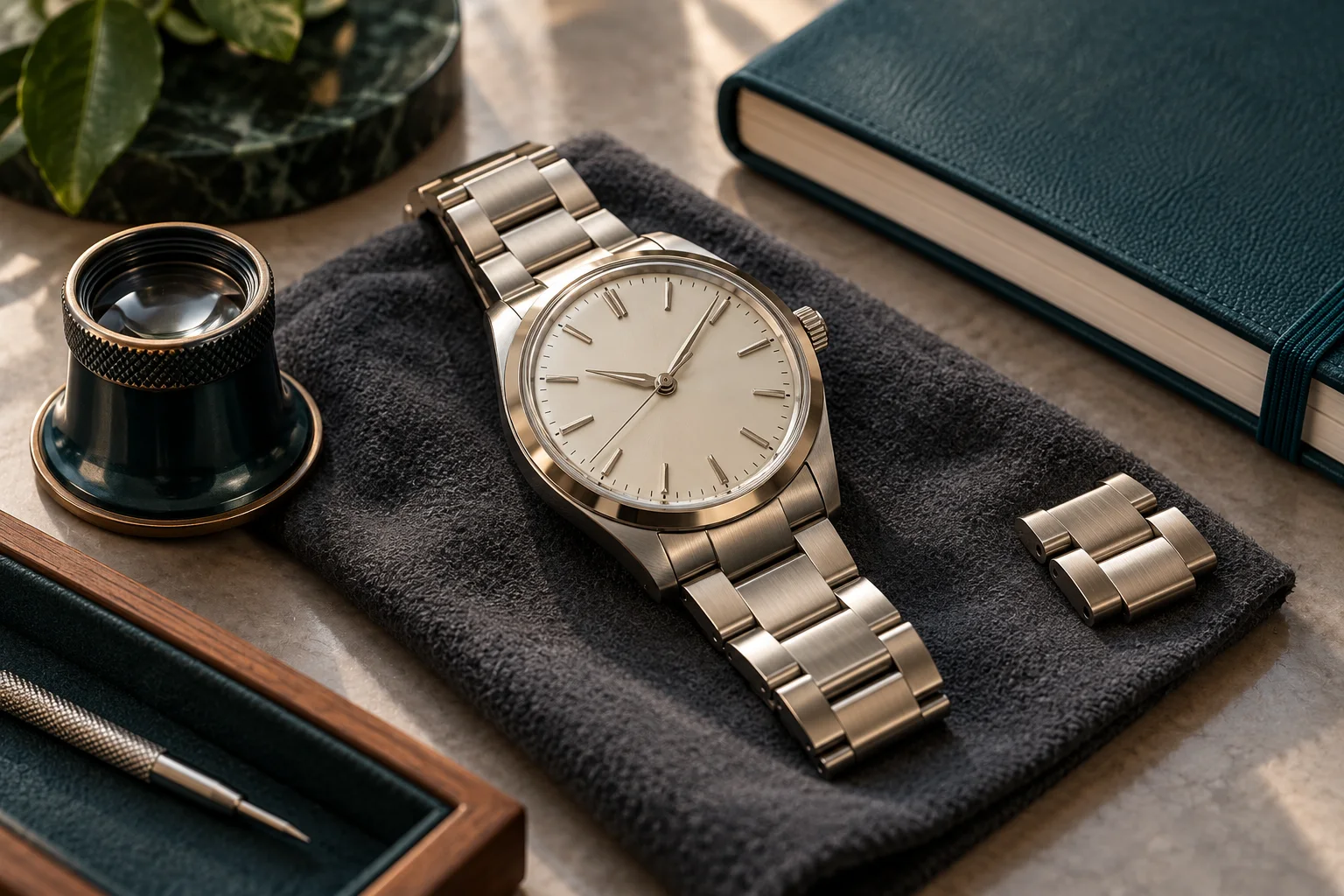
Connect each document with the watch being offered
Start with the exact reference and a description of the configuration: material, dial, bracelet or strap, and relevant measurements. Request images of the actual watch rather than relying on stock photography. If a feature determines your interest, confirm that it belongs to the offered example. A representative image from the same family cannot answer a question about a particular dial, clasp, or set of included components.
Sort the paperwork by purpose. An invoice records a described transaction. A service receipt covers particular work. A card may relate to coverage with its own conditions. Check that references and dates do not conflict. Where personal information is redacted, work out what you genuinely need to connect the document with the watch without circulating details about previous owners.
Do not turn the presence of a box and papers into automatic authentication. Ask who supports the provenance claim, what checks are offered, and how a discrepancy would be resolved. If the seller says the watch belongs to a brand's certification program, request the specific evidence associated with that program. Similar marketing language does not establish that the relationship exists.
For example, the Rolex Certified Pre-Owned program describes its own verification process and documentation. That information applies to watches included in the program, rather than every used Rolex. It helps you examine a specific claim, not transfer the same assurance to a different watch or any seller using the brand name.
Ask what changed, who did it, and what was recorded
“Serviced” is not a sufficient explanation without the work behind it. Ask whether the watch received a diagnosis, movement servicing, a particular repair, or exterior treatment. Establish who performed each task and what paperwork exists. A service date can be useful, but it does not by itself describe replaced parts or establish the watch's condition today.
Request information about replaced visible components and other work the seller knows about. The point is not to assume that every change is undesirable. Repair can be part of maintaining a used watch. What matters is whether the resulting configuration matches what you want and whether the listing describes it clearly. If the answer is unknown, record that rather than filling the gap with an assumption.
Discuss polishing and exterior refinishing separately. A shiny surface tells you little about the mechanism. It also does not establish whether contours and finishes match what you want to preserve. Ask for clear photographs in even lighting and an explanation of any treatment. Avoid demanding a flawless appearance without first deciding whether you prefer visible wear or are comfortable with cosmetic work.
If coverage from previous servicing remains relevant, request its terms and check which watch and work it identifies. Do not combine periods or treat purchase coverage and repair coverage as interchangeable. This article does not set out a universal legal guarantee. Your position depends on the documents, seller type, and rules applying to the particular transaction.
Look at the case, crystal, crown, and clasp without improvising a diagnosis
Inspect the watch over a safe surface with the seller's permission. Examine the crystal, case, lugs, crown, bezel, and clasp in adequate light. Look for damage absent from the photographs and compare what you observe with the agreed description. You do not need to interpret every mark as a fault. Describe its location and ask for clarification where it could affect your intended use.
During an authorized demonstration, check that the clasp opens and closes normally and observe how the watch sits on your wrist. If a control resists movement or you do not know how it operates, do not force it. Setting procedures depend on the model. Use its manual and leave unfamiliar adjustments to someone competent to perform them.
An exterior inspection cannot establish internal condition or water resistance. Do not immerse a used watch as a test, or transfer a rating from the original specification to the condition of the watch in front of you. If demanding use is part of your plan, raise that requirement before buying and request a relevant assessment. A home observation and a workshop test answer different questions.
Define what you need to know before arranging an assessment
A professional consultation becomes more useful when it begins with specific questions. Explain that you are considering buying this example and establish whether you need information about performance, recommended work, or the feasibility of sizing. Ask what the assessment includes, what remains outside its scope, and whether you will receive a written conclusion. Do not assume that every inspection includes comprehensive authentication.
TUDOR describes a servicing procedure beginning with an examination of the case, bracelet, and movement and an itemized estimate. Its explanation distinguishes mechanical work from optional exterior refinishing and includes performance and waterproofness checks. This describes that service, rather than the offering of every workshop or work already performed on the particular watch you are considering.
If work is recommended, obtain an estimate for this watch and ask what happens if additional needs are discovered. Separate necessary work, cosmetic options, and tasks that professional advice indicates can wait. Do not base the purchase on a generic figure you saw for another reference. You also need to establish whether the expected turnaround fits the date by which you hope to have the watch available.
| Area | What to ask | What to keep |
|---|---|---|
| Performance | What was checked and under which conditions | Written findings and limits of the assessment |
| Work | Which tasks are recommended and which are optional | An itemized estimate for this example |
| Sizing | Which components are needed for your wrist | Measurements and included or missing parts |
| Intended use | Whether the assessment covers your planned activity | Specific conditions and recommendations |
An inconclusive result is still a result. If another examination is needed to answer a question, establish its scope and who must authorize it before proceeding. Silence in a report is not confirmation of something that was never assessed. Your final decision should recognize which questions have received an answer and which remain open.
Fit depends on what is supplied, not just case diameter
Before completing the purchase, measure your wrist and confirm the usable bracelet or strap length. Ask how many spare links are included and whether anything needed for sizing is missing. A watch that appears suitable in a photo may need components not supplied with that example. Do not assume any similar-looking link will suit the particular reference and clasp.
During a fitting, consider how the case rests and whether the clasp feels comfortable in a normal position. Do not overtighten the watch to compensate for the wrong length or accept an improvised fit as a finished adjustment. If you need a different strap, establish compatibility, measurements, and cost beforehand. The possibility of changing it does not mean the change is included in the purchase.
Keep an inventory of what will be handed over: watch, spare links, straps, tools where applicable, and identified documents. If work has been agreed before delivery, record who will perform it and how you will verify the result. A clear inventory prevents later confusion over accessories that appeared in a photograph for presentation purposes but were never included in the offer.
Use a short purchase file and check what arrives
Keep the description, photographs, answers, and estimates together. Identify confirmed details, accepted limitations, and unresolved questions. If the purchase only works financially when you assume no further work will be needed, revisit the evidence. This guide provides neither market prices nor a fixed maintenance percentage. The useful figure is an estimate that applies to the example being assessed.
When the watch arrives, compare the reference, condition, and supplied components with that record. Document any difference and use the seller's stated contact route. For a transaction on PakaPuka, consult its delivery and returns guide and the listing's own terms. A handover photograph does not replace an outstanding inspection or automatically expand any coverage.
For ongoing care, find the instructions for your reference. Rolex provides care and use guidance and directs readers to model-specific guides. Avoid transferring cleaning, winding, or setting instructions to a different watch merely because the brand or appearance is similar. Keep documentation of future work as well, so the history remains understandable.
You can explore the PakaPuka shop or its watch section, distinguishing direct purchases from paid participation. Each listing lets you check the described condition, current availability and terms. If a participation format interests you, read the relevant guides before taking on its costs.
Frequently asked questions about inspecting a used watch
Are a box and papers enough to confirm authenticity?
They cannot answer every question on their own. Check the connection between the paperwork and the particular watch, and understand who stands behind authenticity claims. Where necessary, request an assessment with a clearly defined scope before buying.
Does a running watch need any further checks?
Seeing it run is a limited observation. You may still need information about servicing, sizing, or intended use. Identify what you need to know and which assessment could answer it, rather than treating everything unexamined as satisfactory.
Does servicing always include polishing and replacement parts?
Do not assume so. Request the details of the actual work and distinguish necessary operations from cosmetic options. A brand's explanation of its service does not automatically describe another workshop's offering or an earlier intervention.
What if the supplied components cannot make the watch fit?
Before buying, establish whether compatible components can be obtained and what they would cost. If you discover the issue after delivery, compare the contents with the agreement and contact the seller. Do not force an adaptation that could damage the watch.