
Watch buying guide
To choose a watch size online, compare its case diameter, lug-to-lug length and thickness with a watch you already find comfortable. Then check the strap or bracelet's usable length. Your wrist circumference helps you investigate fit, but it cannot tell you a single correct case diameter: the shape of the case, its lugs and the way the band bends all matter.
This guide gives you a practical way to read a listing, request missing measurements and narrow your shortlist before paying. It covers small wrists as well as larger ones, without assigning styles to genders or presenting a universal sizing chart. The aim is a watch that suits your daily routine, rather than an impressive number in a specification table.
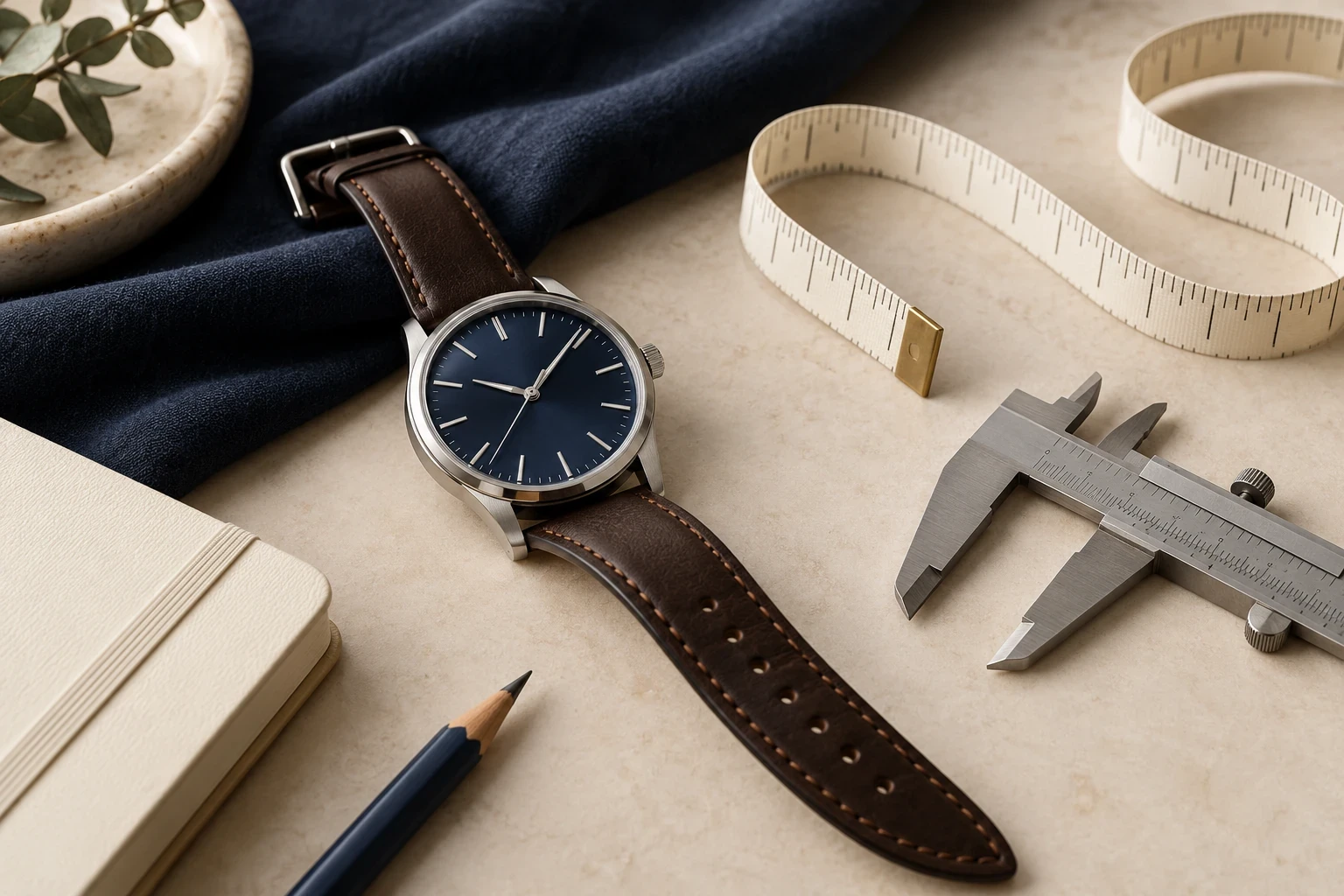
Start with a watch you already enjoy wearing
A familiar watch is often a better starting point than a chart assigning a case diameter to your wrist size. Write down what works about it: whether it stays where you want it, slips under a cuff, feels balanced while typing and lets you read the time without effort. If something annoys you, record that too. A larger replacement will not necessarily fix a small dial if the real problem is low contrast or a crowded display.
Find the exact reference of that watch and check its manufacturer's specifications. Record the diameter, thickness and overall length across the lugs, where those figures are published. Keep your observations separate from the numbers. Knowing that you like one 40 mm case gives you a useful comparison; it does not prove that every other 40 mm watch will feel the same.
If you do not own a watch, try a few in person before choosing online, when practical. You are gathering a reference for your own preferences, not committing to a brand or price bracket. A quick try-on cannot show how a watch feels after an entire working day, but it can reveal a case that rocks on your wrist or a crown that presses against your hand when you bend it.
Read the dimensions as different pieces of information
Case diameter usually describes the width across a round case, while thickness describes its height. A listing may not make clear whether protruding controls are included. Ask when that distinction affects your choice. For a rectangular or square watch, compare both case dimensions rather than treating one side as equivalent to a round diameter. The outline and corners change what occupies the top of your wrist.
Lug-to-lug length runs from one end of the case's lugs to the other along the direction of the strap. Lug width is the gap where a strap attaches. They answer different questions. The first helps you investigate the watch's footprint; the second helps identify compatible replacement straps. A 20 mm strap measurement is not a 20 mm case length, and neither number tells you the complete bracelet length.
| Detail | What it helps you assess | What remains to check |
|---|---|---|
| Case diameter or width | The case's width across your wrist | Case shape and whether the crown is included |
| Lug-to-lug length | The case's length along the strap | Lug curvature and rigid bracelet end pieces |
| Thickness | The height of the watch above your wrist | Case profile, balance and sleeve clearance |
| Lug width | The strap attachment size | Attachment design and actual strap compatibility |
| Usable band length | Whether the complete watch can close around your wrist | Included links, adjustment positions and clasp design |
Treat missing dimensions as questions, not reassuring blanks. If a listing supplies only diameter, you still have an incomplete description of fit. Manufacturer information can fill some gaps when the exact reference matches, but it will not tell you which links remain in a used bracelet or whether someone has replaced its original strap. Those details belong to the particular item being sold.
A smaller diameter can come with a longer case
Two manufacturer specifications illustrate why a single size number is not enough. Seiko lists the SRPD55 at 42.5 mm in diameter and 46.0 mm lug to lug. Its SRPG31 has a smaller 39.4 mm diameter but a longer 48.1 mm lug-to-lug measurement. These are examples for reading specifications, not a recommendation, a stock claim or a promise that either will fit you.
The comparison does not establish which watch feels smaller overall. It shows that reducing diameter does not automatically reduce every dimension. Before choosing between two references, compare their outlines, the shape of their lugs and the band each uses. Keep the specifications attached to the exact reference so that a similar product name does not quietly replace the watch you meant to assess.
A broad bezel can also leave a different visible dial area from a thinner bezel on a case of similar width. That is a reason to inspect the display, not to infer an unpublished measurement from a photograph. Look for clear, straight-on images, then consider how you read a watch during the day. Presence, legibility and physical comfort are related preferences, but they are not interchangeable specifications.
Measure your wrist without turning it into a rigid rule
Measure where you normally wear a watch, with a flexible tape resting against your skin rather than pulling it tight. Record the units and repeat the measurement if the first result seems uncertain. A strip of paper that you mark and then measure against a ruler can help when you do not have a suitable tape. Follow a manufacturer's specific fitting instructions when ordering a bracelet adjustment from that maker.
Use the result to ask whether the complete watch and band can accommodate you. Do not divide it by an arbitrary constant and treat the answer as the only acceptable case diameter. Two wrists with the same circumference can have different shapes, and two people can prefer different amounts of visual presence. Your measurement supports a conversation with the seller; it cannot replace how the watch actually sits.
A photo taken directly above your wrist can make a useful personal record when comparing watches you have tried. Keep the camera distance and angle reasonably similar, and avoid letting a close-up become the only view. It still cannot demonstrate pressure, balance or comfort. If you are uncertain between two options, record what remains unknown instead of forcing a precise conclusion from a photograph.
A suitable case still needs a band that works
For a leather, textile or rubber strap, ask about its fitted length and adjustment range, not just the material. The position of the available holes matters, as does the amount of strap left beyond the buckle. Check whether the watch uses a standard attachment or a proprietary design before budgeting for a replacement. A matching nominal width alone does not guarantee that a different strap will fit correctly.
For a bracelet, request the number of fitted and spare links, the wearable length as supplied and the adjustment options available on that exact clasp. A used watch may arrive with links removed, and replacement components may need a separate quote. Do not assume that a feature advertised for a brand exists on every watch it makes. Ask for a clear photo of the actual bracelet and clasp offered with the item.
Rigid end pieces deserve attention because they can extend the part of the watch that does not immediately bend around your wrist. A bare case measurement may therefore leave an important question unanswered. A side view can help show where the bracelet starts to articulate, although a photograph remains an estimate. If this is likely to decide the purchase, ask for additional information before paying rather than planning to solve it later with an unverified strap swap.
What photos and paper outlines can tell you
A paper outline can help you visualize approximate case width and length when you have reliable dimensions. Print at the intended scale and check the output with a ruler; a printer's automatic fit-to-page setting can change it. Use manufacturer templates according to their instructions when available. The exercise is a rough view of the footprint, not evidence of how the case's underside or strap will follow your wrist.
Paper cannot reproduce thickness, weight, a clasp or the stiffness of a bracelet. A promising outline should therefore lead to more questions rather than a guarantee of comfort. Consider your routine as well: a watch that looks appealing in an overhead image might still be inconvenient under your usual sleeve. Keep the distinction between what you have measured, what you have seen and what you still need to try.
Send the seller questions they can actually answer
A useful message identifies the exact listing and asks for specific missing facts: the reference, case measurements, usable band length, spare links and adjustment options. Explain which dimension you are trying to compare. A request such as “Will this suit my wrist?” invites an opinion; asking for the complete fitted bracelet length and a side-on photograph gives you information you can assess yourself.
If the listing is for a used watch, request photographs of the actual item, including both sides of the case, the clasp and any included extra links. Confirm which strap or bracelet is part of the sale. Manufacturer images can explain a reference, but they do not establish the condition or accessories of that particular watch. Keep the seller's answers with your notes so they remain tied to the listing you assessed.
Turn the information into a buying decision
Make a short comparison sheet for your final choices. Give each unknown its own space instead of silently assuming the best answer. If case length is missing and the seller cannot confirm it, decide whether you can try that reference elsewhere or prefer another listing with clearer information. A lower advertised price does not resolve a fit question, and an expensive watch does not automatically offer a better adjustment range.
Include any confirmed fitting costs in your purchase comparison, such as a quoted replacement strap or additional bracelet links. Check the seller's delivery and return terms for your location before paying, including any conditions that apply after resizing. This guide does not state a universal return entitlement or promise that alterations are reversible. Keep the terms for the particular sale alongside the measurements you used to decide.
On PakaPuka, review the actual product page and its purchase conditions when a suitable watch appears in the related selection. Direct purchase and paid participation have different purposes and costs; placing bids is not a substitute for buying a watch that fits. The live selection can change and does not imply that a reference discussed in this guide is currently available.
Common questions about watch size
Is a 40 mm watch too big for a small wrist?
Diameter alone cannot answer that. Compare lug-to-lug length, case shape and band articulation with a watch you know, then consider your own preference for presence. A seller's measurements and a practical try-on offer more useful evidence than a universal cutoff assigned to a wrist circumference.
Are lug-to-lug length and lug width the same?
No. Lug-to-lug describes the overall case length along the direction of the strap; lug width describes the gap at the strap attachment. Keep both in your notes and confirm how a listing labels them. Mixing them up can lead to a poor case comparison or an unsuitable replacement strap.
Will changing the strap make an oversized watch fit?
A different compatible strap may alter how the watch sits, but it does not shorten the case or guarantee comfort. Verify attachment compatibility and cost first. If the case itself extends beyond the area where you want it to rest, a strap change may leave the original concern unresolved.
Can I choose a watch entirely from wrist photographs?
Photographs are useful for comparing appearance but cannot show balance or pressure and may distort proportions. Combine them with reliable dimensions and details of the actual band. When possible, try the reference before committing; if that is impractical, be clear about the uncertainty and check the particular seller's terms.
Sources and scope
The two Seiko product pages linked beside the dimensional comparison are primary manufacturer sources for those exact references. The surrounding comparison method is editorial guidance, not a manufacturer fit guarantee. Measurements, accessories and sale conditions still need checking for the actual listing. This guide does not rank current offers or identify the unbranded watch in the illustration as a product for sale.